
6 Month Twin Sleep Schedule: A Simple Routine That Actually Works
If you've been searching for a 6 month twin sleep schedule, you're probably exhausted.
Not just tired-from-last-night exhausted.
Six-months-into-this-and-I-don't-know-how-much-longer-I-can-do-it exhausted.
Maybe your twins are still taking short naps. Maybe one twin sleeps great and the other is up every two hours. Maybe bedtime has become something you dread instead of something you look forward to.
Or maybe what worked when they were newborns has quietly stopped working, and nobody told you that was going to happen.
Here's what I want you to know: six months is actually one of the most hopeful ages in twin sleep.
Your babies are no longer tiny newborns who need constant feeding and soothing around the clock. Their wake windows are getting longer, their sleep cycles are maturing, and they're capable of following a much more predictable rhythm than they were just a few months ago.
If you feel stuck in survival mode right now, this is often the exact turning point families I work with needed.
Why Six Months Is a Turning Point for Twin Sleep
One of the biggest challenges of raising twins is that you're not managing one baby's sleep, you're managing two humans.
During the newborn stage, following each baby's individual sleep cues often makes sense. But by six months, many twin families find themselves trapped in a cycle of unpredictable naps, inconsistent bedtimes, and two babies operating on completely different schedules.
The result?
You never know when you'll get a break.
One twin is sleeping while the other is awake. Then they switch. Before long, you're spending the entire day managing sleep instead of enjoying your babies.
I lived this with my own twins.
When my twins were around four to five months old, I was still following their individual cues because that's what had worked with my oldest daughter. But with twins, what I actually created was two separate schedules, two separate nap routines, and a level of exhaustion that felt impossible to sustain.
Everything changed when I switched to a parent-led approach designed specifically for twins.
What I've Learned Working With Twin Families
As a registered nurse, certified sleep consultant, and twin mom, I've worked with twin families from all over the world.
And I've noticed something interesting.
The families who make the fastest progress aren't necessarily the families working the hardest.
They're the families who stop trying to manage two completely separate babies and start creating a plan built specifically for twins.
Because twin sleep isn't just singleton sleep multiplied by two.
It's its own thing.
What Do Most 6-Month-Old Twins Need?
While every baby is different, most 6-month-old twins do well with:
14–15 hours of total sleep in a 24-hour period
Three naps per day
Wake windows of approximately 2–3 hours
A bedtime between 6:30 PM and 8:00 PM
The exact clock times matter less at this age than the overall rhythm.
When babies experience a predictable pattern of sleep and wakefulness, their bodies begin to anticipate sleep naturally. That often leads to smoother naps, easier bedtimes, and fewer struggles throughout the day.
Now that your babies are likely rolling, it’s important to continue to follow safe sleep guidance and ensure that the sleep space is free of blankets, pillows, bumpers, and plush toys. By now, if you haven’t moved your babies out of their swaddles, it’s important to do so ASAP and use an approved sleep sack instead. Even if they can roll, continue to place them on their backs when you lay them down.
A Sample 6 Month Twin Sleep Schedule
Here's an example of what a successful day might look like:
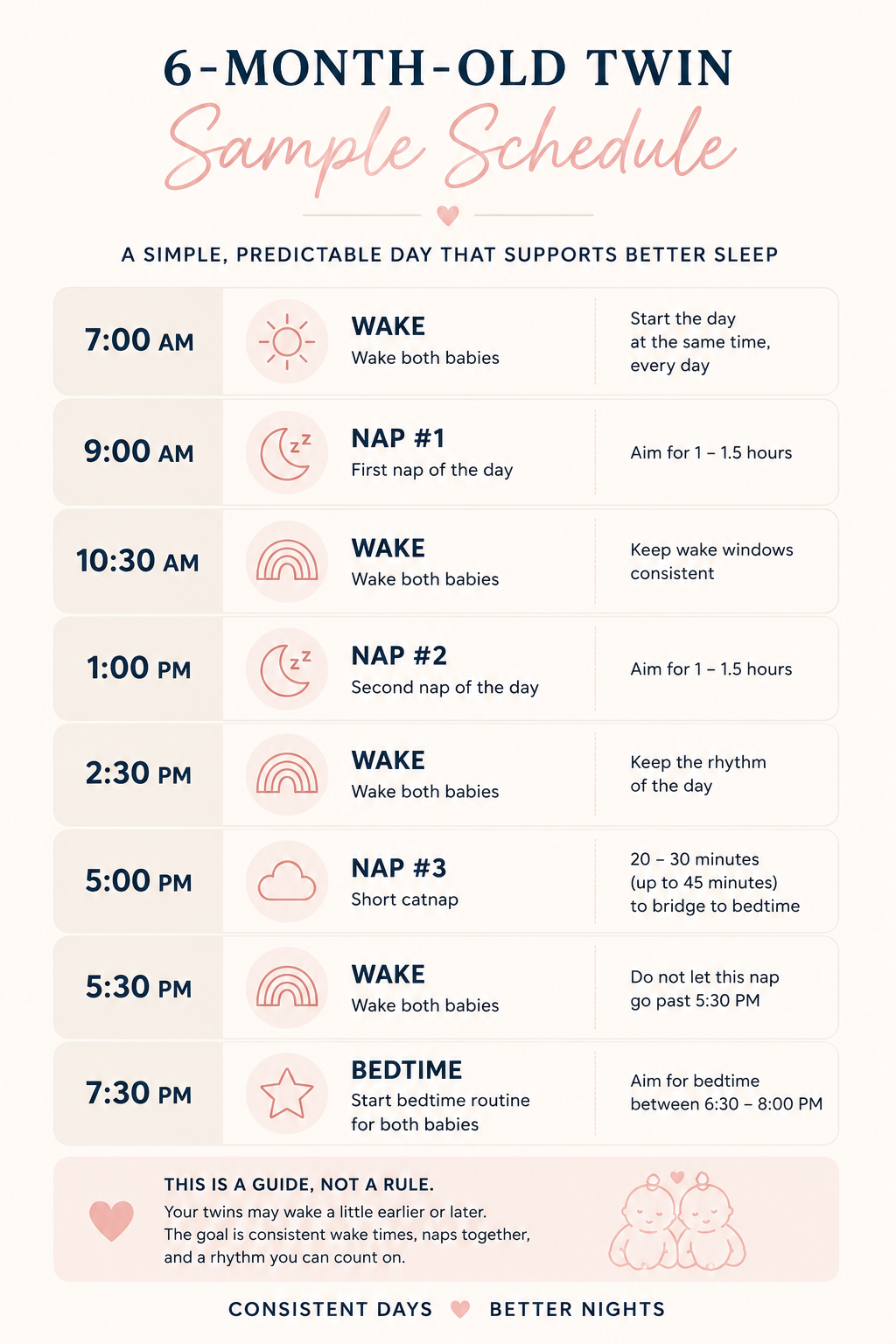
Remember: this is a framework, not a rule.
Your twins may wake at 6:30 AM instead of 7:00 AM. That's okay. The goal isn't forcing babies into exact clock times.
The goal is creating a rhythm where both babies move through the day together.
The Mistake Most Parents Make With Schedules
Here's where many families get stuck.
They assume the magic is in the clock times.
It's not.
I've seen twin families use nearly identical schedules and get completely different results.
Because the schedule itself is only one piece of the puzzle.
What matters just as much is how you respond when one twin wakes early, how you handle missed naps, how you coordinate different temperaments, and how you build independent sleep skills within the structure of the day.
That's where most twin families need support.
I wrote a whole articles about the Top 5 Twin Sleep Mistakes You Don’t Even Know You’re Making, that walks through some of the most common issues twin parents face when it comes to sleep. Check out the article HERE
The Three Things That Matter Most
Many parents assume success comes from finding the perfect schedule.
In reality, three habits tend to make the biggest difference.
1. A Consistent Morning Wake Time
This is probably the single most important piece of the entire puzzle.
And it's the one most twin parents skip because it feels completely wrong.
When one twin is still sleeping peacefully, waking them feels counterintuitive.
But when one twin sleeps significantly later than the other, the rest of the day often starts unraveling.
Nap timing shifts.
Wake windows stop lining up.
Bedtime becomes unpredictable.
A consistent morning wake time creates the foundation for everything that follows.
2. Coordinated Naps
One of the biggest benefits of a synchronized twin schedule is that both babies sleep at the same time.
That doesn't mean they're identical.
One twin may fall asleep immediately.
The other may spend a few minutes quietly winding down in the crib.
That's okay.
A baby calmly resting in their crib is not a problem. It's a skill they're learning.
And it's a skill that makes life with twins dramatically easier over time.
3. A Protected Bedtime Window
When naps go poorly, many parents assume they should push bedtime later.
Often the opposite works better.
A rough day frequently calls for an earlier bedtime, not a later one.
For most 6-month-old twins, protecting a bedtime window between 6:30 PM and 8:00 PM helps prevent overtiredness and supports better overnight sleep.
Common Questions About a 6 Month Twin Sleep Schedule
Should I wake a sleeping twin?
In many situations, yes.
Keeping twins reasonably coordinated throughout the day often leads to more predictable naps and smoother bedtimes.
The short-term discomfort of waking a sleeping baby can create much easier days overall.
What if one twin wakes early from a nap?
Sometimes babies wake briefly between sleep cycles and settle back to sleep on their own.
If not, small adjustments can often help keep the twins coordinated without dramatically shifting the entire day.
What if one twin seems to need more sleep?
This is extremely common.
The goal isn't creating identical babies.
The goal is creating a schedule that respects both babies' needs while still keeping the family functioning.
What if my twins are already on completely different schedules?
You're not alone.
This is one of the most common situations I see.
The good news is that bringing twins back into alignment is usually much easier than parents expect once they understand which adjustments matter most.
What One Family Experienced at Six Months
One family joined the Twin Sleep Academy when their twins were right around six months old.
The babies were taking short catnaps throughout the day, naps were happening wherever they could get them, and bedtime felt completely unpredictable.
Mom felt like she was failing.
She wasn't.
She simply didn't have a plan built for two babies.
Within one week of implementing a more structured approach, the twins were following a much more predictable rhythm. Night wakings dropped significantly, naps became more consistent, and mom finally felt like she could breathe again.
Not because the babies changed.
Because the plan changed.
The Difference Between Overwhelmed and Confident
The biggest difference between twin families who feel constantly overwhelmed and those who feel confident usually isn't the babies.
It's the framework.
When you know what your twins need and have a plan designed specifically for two babies, sleep stops feeling like guesswork.
And that's when life with twins starts becoming enjoyable again.
Ready for the Next Step?
If this article helped, start with my free guide:
Top 5 Twin Sleep Mistakes You Don't Even Know You're Making
Inside, I'll walk you through the most common mistakes twin parents make—and the simple changes that often create the biggest improvements.
Need Personalized Help?
If you're trying to figure out why your twins are waking overnight, taking short naps, or refusing to stay on the same schedule, my Sleep Strategy Session may be a great fit.
We'll review your twins' sleep, identify what's keeping them stuck, and create a plan that actually works for your family.
Many parents discover that a few small changes make a much bigger difference than they expected.
And if you're looking for ongoing support, Twin Sleep Academy includes age-specific schedules, coaching, and twin-specific sleep strategies designed for real life.
A 6 month twin sleep schedule doesn't have to feel complicated.
With the right framework—and the right support—better sleep may be much closer than you think.
Click the image below to watch the YouTube episode on how to get your 6 month old twins on the same schedule.
Click the image to watch the YouTube episode on this topic.